



System Configuration: i5@3.3GHz Processor, DDR 3, 4 GB RAM, 500GBSATA Hard Disk, AOC 15.5 LCD.
System Details: 20
Labs Conducted:
- ME-VLSI LAB
- Project work

National/International Conferences:
| Batch | Student’s Name | Title of the Paper | Name of the Journal / Conference |
|---|---|---|---|
| 2013-2015 | S. Sharmila | Design and Implementation of CMOS gates for multiple valued logic digital circuits | International Conference on Recent trends in Computer science & Engineering (ICRTCSE 2015) |
| 2013-2015 | S. Manicka Vinodhini | A Novel data hiding technique via RCM and AES Encrypted Images. | International Conference on Research Methods in Engineering and Technology |
| 2013-2015 | H.A. Hajan | Realizing Multiplexer based full adder in multi precision multiplier | International Conference on Advances in Applied Engineering and technology-2015 |
| 2013-2015 | K. Maniyarasan | To improve OFDM standards using pipelined parallel FFT architecture. | International conference on applied research in engineering and technology-2015 |
| 2013-2015 | E. Preethi | A cryptographic algorithm for reduced area costs | International Journal of Applied Engineering Research |
| 2013-2015 | R. Samundeeswari | Implementation of FIR Filter Design Using Area – Delay – Power Efficient Carry Select Adder | International Journal of Applied Engineering Research |
| 2013-2015 | S. Saranya | An Effectual Technique for Procuring Fractional and Integer-Order Byproducts of Radio Frequency Signals | International Journal of Applied Engineering Research-2015 |
| 2013-2015 | R. Ashwini | A novel methodology for N-bit full comparators using Quantum Cellular Automata | International Journal of Applied Engineering Research-2015 |
| 2013-2015 | T. Thangakasi | Design and Synthesis of 32-bit Reversible Arithmetic and Logic Unit with 16- Operation | International Journal of Applied Engineering Research-2015 |
| 2013-2015 | V. Manikandan | Implementation of FFT Using Vedic Multiplier for Enhancing the Speed | International Journal of Applied Engineering Research-2015 |
| 2013-2015 | M. Nivetha | Improved 16-Point Approximate DCT for Image and Video Compression Requiring Only 28 Additions | International Journal of Applied Engineering Research-2015 |
| 2013-2015 | R. Sakthi Priya | Efficient high throughput multi standard transform core realization on FPGA | International Journal of Applied Engineering Research-2015 |
| 2013-2015 | K. Sangeetha | An Efficient Aging Aware Column Bypass Multiplier Using Adaptive Hold Logic | International Journal of Applied Engineering Research-2015 |
| 2013-2015 | T. Srivinodhini | Hand Gesture Based Low Cost Television Control System | International Journal of Applied Engineering Research-2015 |
| 2013-2015 | S. Sofia | An 8T low selection and low voltage SRAM using bulk CMOS technology | International Journal of Applied Engineering Research-2015 |
| 2013-2015 | R. J. Shyja | Novel Area Efficient Binary adder in quantum Dot cellular Automata | International Journal of Applied Engineering Research-2015 |
| 2013-2015 | M. Akilandeswari | Reconfigurable fast filter bank for multi standard wireless receiver | International Institute Of Scientific Research And Technology |
UNIVERSITY RANK HOLDERS – 2015
|
Name: S.SHARMILA Rank: 40 Dept: M.E. – VLSI DESIGN |
Name: S.SOFIA Rank: 40 Dept: M.E. – VLSI DESIGN |
UNIVERSITY TOPPERS- 2014
Name: T.LATHA Rank: 42 Dept: M.E. – VLSI DESIGN |
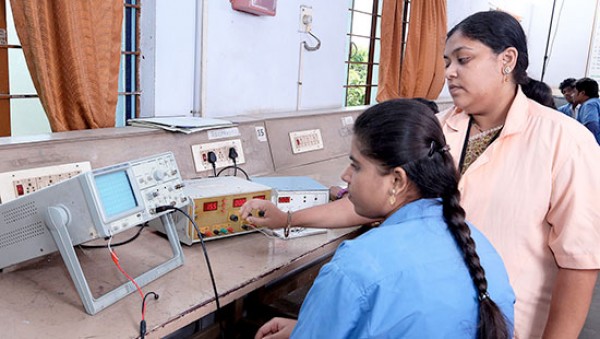
The Department of Electronics and Communication Engineering was established during the year 2001-2002, recognized by AICTE and affiliated to ANNA UNIVERSITY. The department offers a four year degree program in Electronics and Communication Engineering with an initial intake of 60. The intake increased to 120 students since 2002-2003. A two year post graduate program ME in VLSI has been introduced with an annual intake of 18 students during the year 2010-2011.
To offer high quality academic programmes in Electrical and Electronic Engineering, carry out research in particular areas, train professional engineers and collaborate with industry to offer solutions for national development.
Program Outcomes